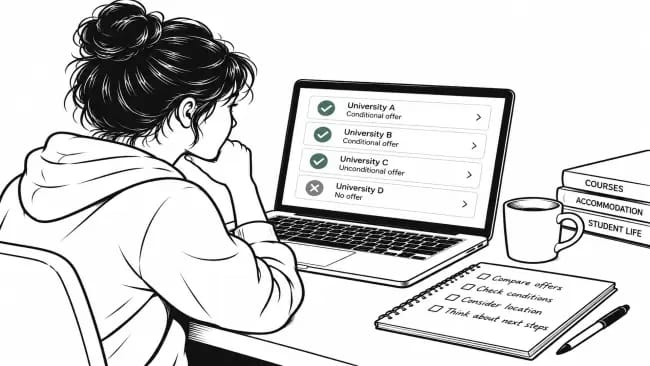
UCAS decisions include conditional and unconditional offers, unsuccessful and withdrawn choices, and changed-course offers. Read the exact conditions and course details before you move on to replying.
Universities make decisions on each course choice separately, and the outcomes don't all have to arrive at once. For each offer, read the conditions and check that the course, campus, start date and entry point are the ones you expected.
A conditional offer has requirements to meet
A conditional offer means the university is offering you a place provided you meet the conditions it has set. For applicants still taking qualifications, the conditions state the results or other requirements the university expects you to achieve. Examples include particular grades in named subjects, a points total or another academic requirement.
Use the exact wording of the offer when working out what you need to achieve. An offer of AAB including an A in Chemistry isn't met by AAB with a B in Chemistry. An International Baccalaureate offer of 36 points overall including 6 in Higher Level English contains both an overall points requirement and a subject requirement. If an offer gives alternative ways of meeting the requirement, keep the alternatives together when you compare it with your other offers.
Where the university includes requirements outside your main exam results, read those alongside the academic conditions. Check any information supplied directly by the university as well as the wording shown in your UCAS application. If a condition or requirement is unclear, ask the university to explain it before you reply.
An unconditional offer has no outstanding academic condition
An unconditional offer means you have already met the academic entry requirements for the place being offered. Future exam results don't determine whether you satisfy that academic offer.
Separate practical requirements still apply where the university states them. UCAS gives examples including providing proof of results, a DBS or PVG check, or meeting medical or financial requirements. Check the full offer and university communications for any tasks that remain. You still need to reply by your UCAS deadline if you want to take the place.
Unsuccessful and withdrawn are different outcomes
An unsuccessful decision means the university has decided not to offer you a place on that choice. The university doesn't always give a reason with the decision. If none is shown, contact the admissions team and ask whether they'll discuss the decision with you.
UCAS uses "withdrawn" when the choice has been withdrawn by you or by the university. Your application shows the reason for the withdrawal. UCAS gives examples such as not responding to university communications or missing an interview. If a university withdrawal is unexpected or the explanation is unclear, contact the admissions team to clarify what happened.
If your original choices leave you without a usable offer, What to Do If You Get No University Offers covers the routes available after that point.
Changed-course offers
A changed-course offer means the university is offering a different course, start date or point of entry, such as starting in a different year, from the one in your original choice.
Compare the course title and code, campus, start date, entry point and any conditions shown. Decide whether you would actually study the alternative on those terms; choosing the university in your original application doesn't automatically make a different course, start date or entry point acceptable.
Changed-course offers also appear during confirmation after results. How UCAS Results Day Works explains what to do if one appears then.
Universities have deadlines for making decisions
For 2027 entry, a university or college has until 12 May 2027 to make a decision on an application submitted to UCAS by the 13 January 2027 equal-consideration deadline. For applications submitted after 13 January but by 30 June 2027, the decision deadline is 14 July 2027.
If a choice is still outstanding after the applicable UCAS decision deadline, UCAS makes that choice unsuccessful. A long wait before the deadline isn't itself a rejection.
Read the complete position before you reply
When every choice has an outcome, UCAS lets you reply to your offers and shows the reply deadline that applies to you.
If one choice is still outstanding and you want to reply to your existing offers, UCAS lets you withdraw that choice. The withdrawal is permanent, so use it only if you're prepared to give up that choice completely. Once you withdraw it, the university is told that you no longer want to be considered for the course.
Before replying, review the status and full wording of every choice, paying particular attention to offer conditions and any changed-course details. How to Choose Your Firm and Insurance Choices covers the next decision: which offer to make firm, whether to use an insurance choice, and how to reply through UCAS.