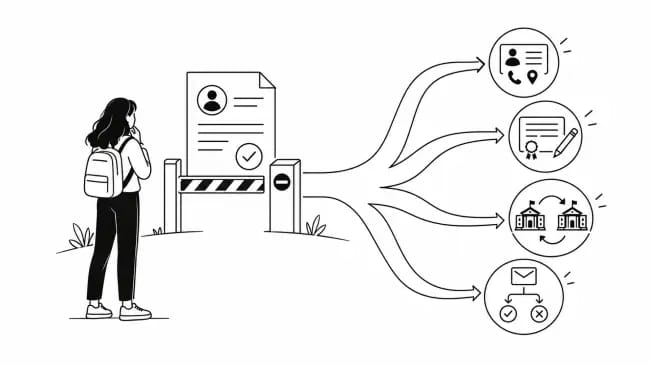
You can’t reopen a submitted UCAS application and edit every section. Contact details, qualification corrections, university choices, course changes and offer replies each follow different rules, so the route depends on what you want to change and how far your application has progressed.
Before you change anything, check the current status in your UCAS Hub. The route depends on whether a choice is still awaiting a decision, you’ve already replied to an offer, or a place has been confirmed.
You can update your postal address, phone number and email address in your UCAS Hub. To change your home address, contact UCAS. UCAS passes updated contact details to your universities and colleges, but tell them directly as well so they have the right information while they are considering your application.
Changes to your name, date of birth or passport details go through UCAS’s update-my-details form. Name and date-of-birth changes require supporting identification, such as a passport, driving licence or birth certificate. Universities also use your email address for direct admissions messages during the period covered in What Happens After You Submit Your UCAS Application?, so update it promptly if it changes.
If a qualification was omitted or entered incorrectly, use UCAS’s qualification amendment form after you receive your welcome email. The form handles omitted qualifications and factual errors in the overall qualification record, including an achieved grade that was entered wrongly when you applied. It can’t change predicted grades, alter unit or module information within a qualification, or add a result received after submission. Tell the universities considering your application about the correction as well, particularly where UCAS can’t make the change itself.
UCAS says qualification amendments take up to 21 days to process. Send the correction as soon as you identify it so admissions teams are working from accurate information.
Your Personal Statement answers are fixed after submission. UCAS can’t edit them or upload a replacement. If there’s a substantive error, or you want a university to consider different material for a changed course, ask that university whether it will accept a replacement statement sent directly to it. Don’t send the replacement to UCAS.
Change a university or course choice
If you want to replace one university or college with another, UCAS gives you 14 days from the date on your welcome email to substitute that choice. During that period, the choice details in your UCAS application show a Substitute choice button. The substitution also has to be made by 30 June, and UCAS allows one substitution per choice.
The substitute uses the same slot as the original choice, so the five-choice limit in How UCAS Choices Work still applies. The original university stops considering your application, and you can’t swap back to it later. If the deadline for the new course has already passed, the substituted application is treated as late. Contact the new university before making the change and check that it will consider you.
If you submitted fewer than five choices, you can add another before 30 June as long as you haven’t replied to any offers. The normal application deadline for the new course still applies. An applicant who originally submitted four choices, for example, can add a fifth without using the 14-day substitution window.
If you declined all the offers you received and still have an unused choice, contact the UCAS Customer Experience Centre to add it. Once all five original choices have been used, there is no unused slot for another ordinary choice. If you later hold no offer, check your eligibility for How UCAS Extra Works.
To change the course, year, point of entry or campus while staying at the same university, contact the university directly. If it agrees, the university tells UCAS and your application is updated. The same process applies after that university has already made you an offer.
Keep the existing choice in place while you ask about a course change. Withdrawing it first removes your application from that university and doesn’t create another choice to use elsewhere.
Withdraw a choice or the whole application
If a university hasn’t yet made its decision and you no longer want to be considered there, you can withdraw that choice. The university then stops considering you for that course, and you can’t use the withdrawn slot for another university. If you withdraw a choice by mistake, contact UCAS immediately. UCAS can’t guarantee that the university will still be able to consider you.
If you are waiting for one remaining decision before replying to offers you already hold, withdrawing that choice lets you move on to your replies. You give up any chance of receiving an offer from the withdrawn choice.
If you cancel the entire application within 14 days of sending it to UCAS, UCAS refunds the application fee. After 14 days, a complete withdrawal doesn’t receive a refund and you can’t submit another UCAS application in the same admissions cycle. If you haven’t accepted an offer, you can withdraw the whole application online.
If you’ve accepted an offer and want to alter your firm or insurance replies, use the reply-change process below. If you’ve accepted an offer but no longer want to go to university or college in this cycle, UCAS says to contact the university holding your place or contact UCAS.
Once Clearing is open, an applicant holding a firm unconditional place can use Decline my place in the UCAS application to give up that place and enter Clearing. Giving up a confirmed place also gives up the contract with that university, so check the position before using it.
Change your replies after accepting offers
If you change your mind within 14 days of replying to your offers, contact UCAS. An adviser can change your replies once during that period without permission from the universities involved.
After 14 days, or if you want to change your replies more than once, speak to the affected universities first and then contact UCAS. The universities must agree to the change, so UCAS can’t guarantee a later reply swap. For 2027 entry, 22 July 2027 at 18:00 UK time is the final deadline for undergraduate reply swaps.
If you haven’t replied yet, make your first replies in your UCAS Hub by the deadline shown in your application. Once you submit a reply, use the reply-change process above if you need to alter it.