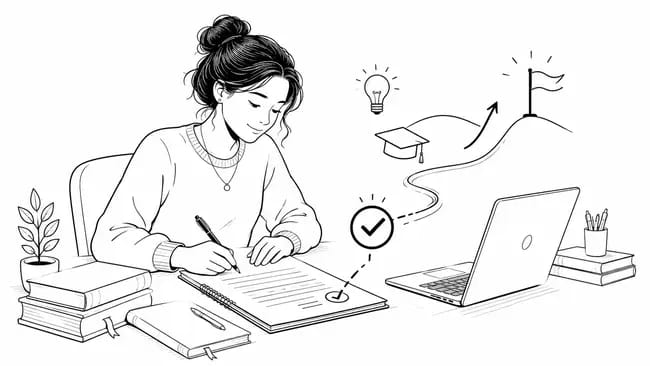
You don't need a separate conclusion that summarises your whole UCAS personal statement. Complete the final point in Question 3 and, where it fits naturally, connect what it shows about your preparation to degree-level study.
The UCAS personal statement is now divided into three questions, so there is no need to force a traditional essay conclusion into the end of Question 3. Admissions staff review the answers as a whole, but each one still needs to answer its own question. Your final lines should finish the material you have chosen for Question 3 rather than repeat what you wrote about motivation and academic preparation in Questions 1 and 2. If you need a fuller explanation of the format, see How the UCAS 2026 Personal Statement Questions Work.
What the ending needs to do
In most statements, the best ending grows out of the final example. If you finish with work experience, volunteering, independent reading or a personal responsibility, explain what you learnt from it and how that learning has prepared you for the course. One or two sentences will usually be enough.
You do not always need a separate closing sentence about the future. A final paragraph that already explains the value of an experience can stop there. Adding a broad line about looking forward to university may weaken a specific point that was already complete.
If the answer does need a clearer finish, use the last sentence to connect what you have learnt with something you are ready to study or develop further. Keep the connection close to the course. “I hope to build on my understanding of experimental design” says more than “I look forward to the opportunities university will bring.”
What to leave out
A summary of all three answers uses characters without adding evidence. Avoid opening the final sentence with “In conclusion” and recapping your motivation, subjects and activities. The admissions reader has just seen them.
Claims such as “I am the perfect candidate” or “I deserve a place” ask the university to accept a judgement that your statement should support for itself. The same is true of lists such as “hardworking, passionate and determined”. By the final line, your examples should already have shown the qualities that are relevant.
Do not introduce new evidence because you have only just noticed it is missing. Either give it enough space earlier or leave it out. An unexplained activity or achievement at the end will feel attached rather than useful.
A weak and stronger ending
Suppose a Computer Science applicant has just described creating a small program and correcting problems in the code. A generic ending would add claims that could belong to almost anyone:
In conclusion, I am passionate and hardworking, and I believe I would be an excellent candidate for Computer Science.
A more useful version completes the example:
Debugging the program taught me to test my assumptions rather than simply add more code, and made me more interested in how efficient systems are designed. I would like to develop that understanding through the theoretical and practical study of computer science.
The revised version gives the activity a point and stays connected to the course. The applicant makes a measured claim about something they have begun to understand and want to study further. If you find it difficult to draw that kind of insight from an activity, How to Reflect on Experience in Your Personal Statement covers the thinking process in more detail.
A short final check
Before you submit the statement, read the final paragraph in context and check:
- Does it complete the last example rather than recap the whole application?
- Have you avoided adding a new experience or achievement?
- Could these lines be attached to another applicant's statement without much alteration?
- Does the ending sound like the rest of your writing?
If the paragraph becomes vague when you try to make it sound impressive, return to the specific experience and what you learnt from it. The final check in Editing and Proofreading Your Personal Statement (Without Losing Your Voice) will help you review the complete set of answers once the ending is settled.