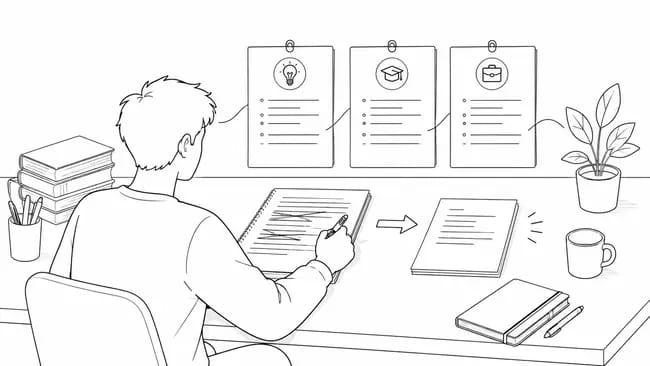
For 2026 entry onwards, UCAS gives you 4,000 characters including spaces across three personal statement answers. The old 47-line limit no longer applies.
You must answer three questions, using at least 350 characters for each:
- Why do you want to study this course or subject?
- How have your qualifications and studies helped you to prepare for this course or subject?
- What else have you done to prepare outside of education, and why are these experiences useful?
Once every answer reaches the minimum, you can distribute the rest of the allowance in whatever way suits your application. Admissions staff consider the answers together as one personal statement. How the UCAS 2026 Personal Statement Questions Work explains the role of each one in more detail.
How does UCAS count the length?
At full length, a personal statement will usually contain roughly 600 to 700 words. The exact total depends on word length, punctuation and spacing, and there is no official word limit. UCAS counts characters, including spaces, so use the counter in the application for the final figure.
The wording of the questions is excluded from your allowance. Paragraph breaks may make your answers easier to read, and you no longer need to compress the text into as few lines as possible.
How long should each UCAS answer be?
The 350-character minimum prevents an almost empty response and will normally be too short for a developed answer. Give each question the space its content requires. A student whose schoolwork is closely related to the course may need more room for Question 2, while an applicant to a course that values work experience may have more to explain in Question 3.
Plan the content before deciding how much space each answer receives, then adjust the balance once you can see which examples need more explanation. What to Include in a UCAS Personal Statement will help if you are deciding which material deserves space.
Do you need to use all 4,000 characters?
You do not need to reach exactly 4,000 characters. A statement can be slightly shorter and still answer the questions properly. Use any available space if you still have relevant evidence or necessary explanation; otherwise, submit the shorter version.
How to shorten a personal statement that is too long
Begin with whole ideas rather than isolated words. Remove evidence that duplicates a point elsewhere, examples with only a weak connection to the course, and background details that the reader does not need. How to Avoid Repetition Across the Three UCAS Personal Statement Questions deals with the first of these in more detail.
Once the content is settled, shorten wordy expressions and repeated descriptions. Keep the explanation that shows what you learnt or how an experience prepared you; cutting that while retaining the name of the activity usually leaves a list rather than useful evidence.