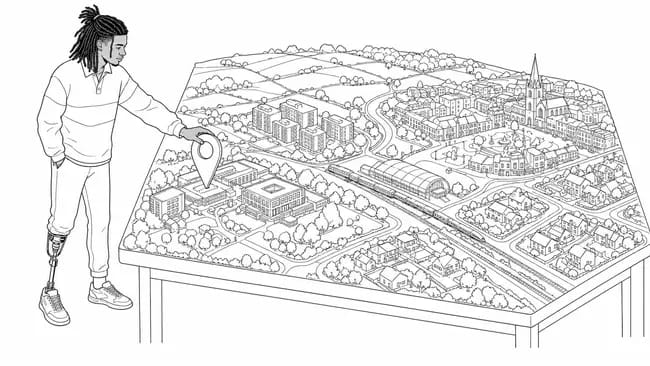
Location shapes the cost and routine around your degree. Compare the life attached to each university before choosing between them.
Choosing a university also means choosing where you will live for the next three or four years. If the rent would stretch beyond your budget or the daily commute would wear down your week, an attractive course won’t make the arrangement sustainable. If you would live comfortably and reach teaching reliably at every university on your shortlist, choose the course you most want to study.
How the location changes your daily life
Campus, city or commute
A compact campus brings teaching, accommodation and university facilities into one area. You can leave a lecture, spend an hour in the library and meet friends without planning transport between them. That convenience suits a life centred on the university, although the same concentration will feel restrictive if you want a clearer separation between studying and everything else.
At a university spread across a city, your course becomes part of a wider urban routine. When your department is in the centre and affordable accommodation lies farther out, each teaching day includes the time and cost of travelling between them. If you expect to work near your department or spend evenings in the centre, the route also connects parts of your week that matter to you.
Living at home creates a different week again. You keep your existing support and avoid the full cost of moving away, while your timetable remains tied to the route into university. A dependable train that gets you to a 9am lecture and still runs after an evening society meeting supports that arrangement. Two unreliable connections will make the same distance much harder to manage.
Follow the route to your course
Find out where your course is taught before judging how convenient a university looks. Institutions with several sites sometimes teach similar subjects in different places, and the main address tells you little about the route from your likely accommodation. Trace that route at the times you would use it, including the walk at each end.
Keep the regular trip to teaching separate from the occasional trip home. A long train ride at the beginning and end of term requires planning, yet it has little effect on your life during term. The route between your accommodation and your course will shape every teaching week, so check that it leaves enough time and energy for study and university life.
Look beyond the university buildings
Read How do you make the most of a university open day? before planning your visit, then leave enough time to see the streets and neighbourhoods outside the organised tour. Walk towards accommodation within your budget and spend time in the area where you would shop or meet friends. Those places will tell you more about daily life than a polished view of the main campus.
Picture where you would go after your last class. If the places you value are close enough to use without planning every trip, they will become part of your week. A city centre full of attractions adds little if you prefer quieter surroundings, while a rural campus becomes restrictive when the activities you value lie beyond the last bus.
What the location will cost and what support it provides
How far your budget will stretch
Your student finance will stretch differently in each location. If rent consumes most of it, paid work will have to cover basic costs as well as any social spending. A lower rent leaves more room in the same budget and reduces the number of hours you need to work alongside your degree.
Use the accommodation you would realistically apply for and calculate its cost across the full contract. The surrounding area changes that figure: if affordable food shops are several miles away or your course is taught on another campus, regular transport will become part of your weekly spending. A room with a lower rent won’t save you much if reaching everything else absorbs the difference.
Imagine that friends from your course meet in the city centre after an afternoon lecture. Joining them adds another return fare to the cost of the evening. Across a full term, that regular expense will influence how readily you say yes, even when the activity itself is affordable.
If your budget only balances once you add paid work, a regular Saturday shift near campus leaves teaching days intact and gives you a predictable income. Working late several evenings because rent has consumed most of your loan will steadily undermine the degree. If those hours are the only way to cover the gap, studying there is too expensive for the funding you have.
Living at home needs a workable week
If you live at home, the saving on rent only helps if the rest of the arrangement allows you to study properly. A direct route with services into the evening leaves you free to use the library after class or stay for a society meeting. An early final bus places an end time on every day and turns an unexpected timetable change into a practical problem.
If you already care for someone at home, beginning a degree won’t remove that responsibility. Travel and teaching will reduce the time available for it, while deadlines will place additional pressure on the evenings you have left. If those demands already fill the available hours, staying at home will leave either your course or the person you support without the time they need.
Living near the university gives you more control over the hours around teaching. When a laboratory runs late or group work continues into the evening, you can stay without reorganising the trip home. If moving away leaves you working so many hours that you lose this freedom again, the additional expense hasn’t produced the life you were paying for.
If family support helps you manage a health condition, moving several hours away means rebuilding that support near the university before term begins. Read Should I stay close to home for university? before assuming that the same help will be available elsewhere.
How to decide whether the location works for you
When two suitable courses lead to different lives
Imagine that you are choosing between two courses you would be happy to study. At one university, you would live on a compact campus where teaching, accommodation and social life are close together. At the other, you would study in the centre of a city and live several neighbourhoods away. The courses have left you with little to separate them, so the life attached to each one now gives you a genuine reason to choose.
An ordinary evening on the compact campus keeps most of your plans within university grounds, with halls and society events close to teaching. At the city university, the surrounding neighbourhoods become part of your week if your work or interests already take you beyond the institution. Attractions you rarely use won’t improve your experience, however impressive they looked during your visit.
Seeing only the streets around the station gives you too little evidence to decide that you would dislike the city. A visit to the neighbourhood around your department and likely accommodation will show you the place you would actually use. High rent needs no equivalent guesswork: once realistic accommodation exceeds your budget, knowing the city better won’t make the arrangement affordable.
When the course points elsewhere
Suppose the city is your preferred location, yet its course takes the subject in a direction you don’t want. The campus university offers the modules you care about and a placement that supports your plans. Choosing the city would leave you living in the place you preferred while spending most of the week on the weaker course. The campus is the stronger university choice.
One course includes an optional module in final year that the other does not. Both core courses still follow the direction you want, and the university without the module offers the location you prefer. Choosing it means giving up one possible part of final year; the rest of the degree still suits you.
Read What should you compare when choosing a university? alongside the two course pages. A distinctive specialism or placement changes the degree enough to justify a location you like less. A single optional module leaves the courses close, so choose the university whose location fits your life.